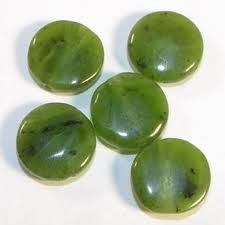
Lapis Lazuli

Lapis Lazuli is a rare, semi-precious stone, highly prized because of its bright blue color. It has been highly valued since antiquity. The finest lapis lazuli gemstones come from northern Afghanistan, in the Badakhshan province. It isn't actually a mineral, but a rock constituting of more than one mineral. The purest of lapis have that intense blue color, with light specks of golden pyrite. Stones with little or no golden pyrite specks and veins have higher value. Usually, stones with inferior quality are dyed to improve its color.
 
Lapis Information

The stone is fairly soft and somewhat porous, thus it should be protected from chemicals and solvents. Lapis are commonly seen in jewelry and ornaments. They are usually cut as beads, or carved into ornamental objects.
The stone is considered as the stone of friendship and truth. It is believed to encourage friendships and relationships, and ward off cruelty and wickedness. It is also known as the stone of truth, and is believed to develop intelligence and inner vision. It helps the wearer conquer misery, fight off nightmares and feel more calm and tranquil.
Origin of the Name Lapis Lazuli
Lapis is the Latin word for "stone", while Lazuli is a genitive form of the Latin "lazulum", which comes from the Arabic word "lazaward", which in turn comes from the Persian word "Lazhvard", which was the name of the place were lapis lazuli was originally mined. The word "azure" (or French "azur", Italian "azzurro", and Spanish "azul") got its name from lazuli, which means the color blue. Taken as a whole, the gemstone means "the stone of Lazhvard".
Where Lapis is Found
The best lapis lazuli gemstones are found in Kokcha River, in Badakhshan, Afghanistan. This has been the mining site of lapis lazuli stones for more than 6,000 years. Badakhshan was the source of the stones since the ancient Mesopotamian and Egyptian period. It still was during the Ancient Greek and Roman civilization, during the Indus civilization, and until now. Apart from Afghanistan, other sources of lapis are in Andes, in Chile, as well as in Russia, Angola, Burma, Siberia, Pakistan, USA, India, and Canada.
History
Lapis Lazuli was a favorite stone in the course of history. Ancient Egyptians used the stone for amulets, ornaments and scarabs. The Ancient Babylonians used the stone for their seals. Cleopatra used powdered lapis as her eye shadow back in the days. As inscribed in the Egyptian "Book of the Dead", the stone was considered an amulet that brings great power. In the ancient Sumerian tombs located in Ur, more than 6,000 beautiful statuettes of rodents, birds and dear were found, made of pure lapis lazuli. Many Akkadian and Sumerian poetry makes reference to the stone as a gem of royal splendor. The stone still holds importance during the Medieval and Renaissance period, as seen in the illuminated manuscripts and panels derived from the stone.
The stone is the most prized blue of all time. They were used as blue paints by painters before 19th century, despite its costly sum. They were grounded up together so that they can be used as paints. Many portraits of the Virgin Mary were created using this expensive blue paint. Unlike other blue paints that tend to pale when in light, it doesn't lose its radiance until this very day. Today, the lapis is still used, though for restoration purposes only.

Kunzite

Kunzite is one of the young gems that are discovered later than most other gemstones. It has fragile pink shade and gaining popularity in this modern times, exhibiting an eye-catching and attractive piece on the jewelry. It was defined and given full description by George Frederick Kunz of New York in 1902 after its discovery in Pala District in San Diego California. And in that time, stones that are discovered are named after their discoverer, thus the stone was named "kunzite".
Kunzite Information
Color
The beautifulness of this gem lies on its fragile pink shades with a touch of violet and clarity. This color makes it feminine, tender and seductive. To enhance its color and see it in full detail, cutter must support and align the unprocessed stone very exactly during work, because the color result depends on the angle of observation. It may appear pink, violet or colorless. This gem also displays a strong property of pleochroism. Some kunzites have light color. Those with strong color are rare and considered valuable.
History and Mines
Kunzite is a member of spodumen group and considered as the youngest one. The crystals of prism-shaped are found in Madagascar, Afghanistan, United States of America, and Brazil. The deposits can be up to several kilograms. It belongs to the group of chain silicates where it contains small amounts of manganese that results its lilac color. But in direct sunlight, the color may fade away. That is why, it is not recommended to wear this jewelry when you will be sunbathing or going out to the beach.
Hardness
This gemstone has a hardness scale of 6.5 - 7. It has a great cleavage making it very hard to cut. But once it achieve its finishing shape, it becomes easy. But re-cutting is very difficult. It is available in beautiful, different cuts. It is relatively big in sizes but in affordable price. In purchasing one, you must always remember that the first thing to consider to know its value is the color and next the clarity. It becomes more valuable when the color gets stronger.
Lore and Healing
This gem is not only popular for lovers, because of its color, but as a stone for healing. It is believed to improve and increase individual's capability for understanding and devotion and brings inner peace to its wearer. It is used by those having strain and worries for it is believe to free us from worries and anxieties. It can be used as part of a ring, necklace, and as pendant. It is a perfect combination for your pastel dresses and also looks perfect for black.
Special Care
To take care of your gem, avoid exposing it to sunlight and high temperature changes. It changes or even fades color over direct sunlight so keep it away from it. Do not use any steam or ultrasonic cleaner. You can use just a mild solution of warm water and mild dishwashing soap to clean the gem. Use soft brush or soft cloth to get rid of dirt. Rinse and dry thoroughly with clean cloth. Avoid contacts to other hard or sharp objects to avoid scratches. Hitting it hard may break it into two pieces. Do not expose in any harsh chemicals. Make sure to keep it separately in a cool location inside your jewelry box. Handle it with care.
This gemstone is popularly known as the patriotic stone of United States in the month of September.

Jasper

Jasper is a gem that is opaque, usually green, red, brown, or yellow in color and is an impure likeness of silica and blue jasper is considered to be a rare variety and some comes with a colors in bands or stripes that is why it is referred to as a striped or banded jasper. This gem can be nicely polished and is used in beautiful jasper jewelry, seals, vases and snuff boxes.
Jasper Information
Terminology and History
When the banded iron formation frequently has distinguishing bands, it is called Jaspilite. Jasper is usually chert which owes the reddish color to iron inclusions. Jasper's specific gravity is in between 2.5-2.9. The gem's name means speckled or spotted stone and came from a Greek word "iaspis". Bow drills are created out of green jasper way back 4th-5th thousand years BCE. Jasper can be traced back in Latin, Hebrew, Persian and Assyrian and have been known as a favorite gem even in the ancient world.
Where Jasper is Mined
This fine-grained opaque gem comes from silica mineral chert are used in ornamentation and jewelry but needs exceptional polishing. Mostly found in Germany, North Africa, Sicily and Ural Mountains. Black jasper became very important because it can be used to test gold of its properties.
Colors
This opaque rock found virtually in any color from the mineral composition of the initial deposits or ash. Patterns take place through the consolidation procedure forming flow and depositional configuration in the original heavy silica volcanic ash or sediment. Hydrothermal circulation is common concept needed in the construction of jasper.
Classifications
This stone can be classified and named depending on its properties and the location where it is found. It can be a lake, a canyon, a river and mountain, some are whimsical like a "Forest Fire" or "Rainbow", and some can be as descriptive as "Dalmatian", "Porcelain" or "Autumn". Few are named from the country where it was found and other materials.
Care & Storage
Always take care of your precious stones. To take care of your jasper stone, do not let it to be exposed from harsh chemicals and high changing temperatures. Do not let it be scratched by hard and pointed objects for it will reduce the quality and good appearance of the stone. The simple way to clean your stone is to use warm water and soap, a mild one. Use this solution with soft brush to take away the dirt that has been collected. Rinse carefully and dry using a clean and soft cloth. Always store your gemstone covered with its own cloth to avoid scratch from other hard jewelry, or better, keep it in a separate place in your jewelry box. When about to use, wear it after all application has been done like spray, perfume and lotion. Do not forget to take it off first before anything else especially when you are about to do special work or chores.
Jasper Jewelry Ideas
This gemstone can be used as pendant. It is also a perfect ornament to your ring, necklace, and bracelet. Some jasper can be carved to a specific figure and can be used as representation. But nowadays, it is used as added design for key ring, pendants and even earrings. It can also be just a simple collection of beads for bracelets.
Because of its high supply and less value, it is used for less expensive jewelry and other objects like candlesticks and ashtray. It can be found anywhere, particularly in clay substance.

Jade

Jade consists of two silicate minerals which are the Nephrite jade and Jadeitite. The origin of the word Jade came from "piedra de ijada", Spanish term for loin stone and is presumed useful in curing disease from kidneys and loins. However, nephrite came from Latin word "lapis nephriticus" meaning piedra de ijada. Although nephrite is softer that jadeite which is as hard as quartz, jadeite is less tough than nephrite and both can be shaped delicately. A French mineralogist on the 19th century found out that jade was really two different materials.
Jade Information
Earliest artifacts of this gemstone came from prehistoric times that were excavated were just uncomplicated ornaments with button, bead, some in tubular form, and was used for knives, axe heads and other weaponry. Jade's beauty as decorative objects and ornaments came more valuable when the metal-working technologies existed.
Durability
Nephrite measures between 5.5-6.0 Mohs hardness while Jadeite is in between 6.5-7.0 that's why it is possible to work with garnet sand or quartz and can also be refined with bamboo.
Colors
Jadeite has lots of color variations like pink, lavender-mauve, emerald green and sometime blue while Nephrite has fewer green color varieties but mostly found in a form of creamy white that is also known as "mutton fat" jade in China.
More on the Different Types of Jade
Jadeite is rare compared to nephrite because it can only be found in less than 12 places around the world. Most expensive variety even in the history and up to present is the translucent emerald-green jadeite. Jade is Wyoming, Alaska and British Columbia's official gemstone wherein it can be found at Cassiar regions and Lillooet in large deposits.
Aside from this gem to be a favorite material for calligraphy brushes, it is also crafted as mouthpieces of opium pipes because they believe that if they breathe through it, smokers benefit longevity. This stone also has a distinctive significance in the Chinese empire in the history of art fairly comparable to diamonds and gold in the West. This gem is used for furnishings of graves only for the imperial family high-ranking members.
Treatments
Stabilization or enhancement of jade can be categorized into three main methods and referred by some as ABC Treatment System.
  • The type A jadeite can only be treated by surface waxing.
  • Type B's outcome has a significant enhancement with regards to its transparency as well as the color of the material. However, it needs to expose a stained piece to acids or chemical bleaches then impregnate it by a clear polymer resin. Presently, the best accurate test is the infrared spectroscopy in polymer detection of jadeite.
  • Type C enhancement is by dyeing or by staining it artificially. Red jade got its red color with the enhancement of heat. To some extent, results are uncontrollable leading to a dull brown in color and usually its translucency is lost. B+C jade underwent the process of both impregnation and dyed artificially.
  • Lastly, type D refers to complex stone like doublet consisting of a jade top with a backing made out of plastic.
Valuing Jade
The worth of jade is revealed by its color, its intensity, its texture and vivacity, its transparency and clarity. Fondness for specific colors differs from various regions and cultures as well. In the regions of Far East, highly esteemed jade are pure white and fine yellow having a delicate pink while in the USA and Europe, valuable one comes from apple green, spinach green, and emerald green.