Tanzanite

What separates tanzanite from any other gemstones is the way in which it was discovered which is entirely unrelated to mysticism or other spiritual beliefs. There are claims that the Masai cattle herders were the individuals who discovered this gemstones after burning occurred from terrible lightning instances happened in Tanzania. However, there is also another discovery version that is more accurate.
Tanzanite Information
True Story On How Tanzanite Was Found
It was said that on the month of July of 1967, one of the local tribesman by the name of Ali Juuyawatu noticed an attractive bluish piece of translucent crystal in Mount Kilimanjaro and decided to take it with him. He then showed it to Manuel D. Souza, who is a tailor and is interested in knowing about rubies in that area. He incorrectly termed it as peridot at first look and then corrected himself upon realizing that his judgment was incorrect. Therefore, he took samples and termed it as "dumortierite" and classified it as a non-gem material.
D. Souza eventually consulted with John Saul, a geologist and wholesaler of gemstones who was in Mount Kenya at that time. Disputing the early claim of D. Souza, he forwarded the discovered crystal to Hyman Saul, who happened to be not only the vice president of Saks Fifth Avenue, but also his father. Upon receiving them, Hyman Saul went to Henry Platt of Tiffany and Company to show it whom coined the term tanzanite. Further experimentations and observation led to the conclusion that it originated from the raw mineral soizite and is highly valued due to its high trichroism property.
Further observation made way to the announcement of Tiffany and Company's marketing launch featuring tanzanite as its primary feature. This event marked the popularity of this gemstone which served as enough reason for the United States Gem Associations to award it as the birthstone for the month of December. These changes were made in 2002 updating the standard birthstone list from 1912.
Where Tanzanite Is Mined
By nature, this gemstone is very rare since it could be found only in the Merelani hills nearing Arusha and Moshi in Northern Tanzania which only extends up to four miles. Because of this, recent efforts are done in order to ensure the security of the Tanzanian cutting industry by having the exporting of unprocessed tanzanite banned. Not only did this help ensure inward flow of profits but also encouraged local production of gem stones.
Colors
Experts base the deep dark blue hue of the gemstone as a basis for grading its value. In order to produce different shades of blue, manufacturers utilize heat treatments. There are also some rare instances wherein a green tanzanite is available. Another development made in order to lessen the coarse property of this gems tone is to apply a certain coating on its surface.
It is therefore not surprising that the demand for this gem stone has been on the rise recently due to the very beautiful bluish sparkle that it has. Currently, the tanzanite is one of the most popular gemstones produces in South Africa and is having great fans from distant countries like Australia, China and India. The popularity of this gemstone has become so sudden and immense that it has even outsold diamond in many occasions.

Sapphire

Sapphire is September's birthstone and comes in every color except red (ruby). Blue is the most common color for sapphire gems. White sapphire is occassionally used as a diamond substitute. Sapphire tennis bracelets are beautiful and loved by many.
 
Sapphire: Regal and Quiet
by Margaret Burgon Klemp

There is more than one way to become a legend. It cousin, the ruby, is well-known because of its' brilliant red color, and because man decided to equate it with their emotions as a symbol of love. But, there is more than one way to become a legend. History is full of legends that were quiet and less bombastic than some of their contemporaries. This is true of gemstones. The sapphire is legendary not because it appeals emotions, but it has an appeal that requires deeper meaning and understanding. It is quiet, it is calm. But its' effect is long lasting. Perhaps that is one reason why it is described in the book of Exodus in the Bible this way. "And they saw the God of Israel; and there was under his feet as it were a pavement of sapphire stone, like the very heaven for clearness." (Exodus 24: 9-10)
Marbode of Rennes (1035-1123) said in his writings:
Sapphire has an appearance
Similar to the heavenly throne;
It depicts the heart of simple men
Waiting with sure hope,
In whose life and ways
The highest is pleased.
Marbode was the Bishop of Rennes in France, and an avid researcher. He composed the earliest and most influential medieval lapidary which described in detail the attributes of sixty different stones. In addition to being an expert on various gemstones he composed hymns, and was a well respected leader and advisor in the Catholic Church. The sapphire has traditionally been involved in the area of religious magic, and it was believed that the owner of the stone could use it to harness psychic powers. It was, and still is, the choice of high church officials and regents especially when their rings are mounted. There are several language origins for the word "sapphire." In Sanskrit it was known as "sauriratna" in honor of the planet Saturn. Ancient Chaldean references called it "sampir," while the Greeks had a modern translation, "sappheiros" which denoted the color blue. The Arabic translation was "safir" and the Latin texts call it "saphirus."
The sapphire does share a lot in common with its' ruby relative, but there are some differences. First of all, the sapphire is must more widespread and more accessible. This is because sapphires originate in the earth's upper crust. The second difference is that it is blue and some natural processes have to occur that are a little different from rubies for a change in color. In some cases, however, early natural metamorphisms are identical to the ruby. They both come from the family of corundums, and share the same attributes of light refraction, density and hardness. Both stones are derived from the same chemical crystallization of alumina.
The sapphire comes in all shades of blue. The most sought after shade is Cornflower Blue Sapphire, the finest of all the sapphires. It is a gleaming blue gem with a touch of purple in it. The Royal Blue variety is velvety and the cobalt in it lets the viewer wonder how deep it really is. Marine Blue sapphires carry the color and dramatic tones of the oceans. Sapphires come in all different shades of blue. Titanium and Iron show up more in the rocks where sapphires are formed, however, they are formed differently all over the world.
In Kashmir sapphires are formed in pegmatites which are veins made up of pegmatite. In the pegmatite formations that are the feeding ground for Kashmir sapphires there is an abundance of aluminum and boron. In the rock surrounding the formation there is iron and titanium present.
In Australia, Cambodia and Thailand sapphires have developed over millions of years from rich deposits of molten carbonatite that has a lot of aluminum mixed with it. At first they were situated deep in the earth's crust where there was a presence of high pressure and extremely high temperatures. It was basalt volcanic activity that propelled them to the surface along with other minerals, and finally they were laid to rest on the valley floors.
In other parts of the world sapphires may have come from ancient formations that were once impure marble which developed over time through metamorphic conditions into crystalline cal silicates known as skarns. A skarn is a metamorphic rock that is usually variably colored green or red, occasionally grey, black, brown or white. It usually forms by chemical processes that form rocks during metamorphism and in the contact zone of magma like intrusions. Skarns in the igneous environment are associated with marble and wider zones of cal silicate rocks. Mixtures of corundum, titanium and iron were also a part of the crystallization process. Because of this process there are numerous inclusions in a sapphire, and like the ruby, they are useful in verification techniques when authenticating the stone.
Sapphires do twinkle. This is caused by the smaller, microscopic stones inside the primary gem that were created at the same time. This twinkling phenomenon is known as "silk" referring to its silky and silvery qualities. It appears as a star that seems to be imposed over a silk like background.
Some of the most important occurrences of sapphires can be found in Sri Lanka, but sometimes access to them is difficult. Pit and river mining are the most used techniques in Sri Lanka, but is impeded because the country resists modernization. Other areas where sapphires can be found are Tanzania, Australia, Madagascar, and Montana (USA).
Honored as the stone of fidelity and chastity, some say it is a sign of peace and friendship, while ancient Romans and Egyptians felt it was a holy stone of truth and justice. Innocent III, during his time as Pope said that every Cardinal and Bishop should wear a sapphire ring on the right hand to be used when they were giving blessings.
The sapphire: legendary, quiet and regal.
References:
Gems: A Lively Guide for the Casual Collector, by Daniel J. Dennis Jr., Henry N. Abrams, Incorporated, New York, New York
Gemstones: Symbols of Beauty and Power, by Eduard Gubelin and Franz-Xaver Erni, Geoscience Press, Tucson, Arizona
Gems in Myth, Legend and Lore, by Bruce G. Knuth, Jewelers Press, Thornton, ColoradO
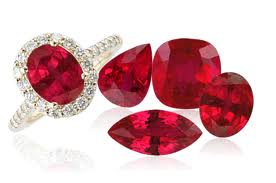
Ruby

Ruby is July's birthstone. Ruby is known as the stone of love. It is worn in all types of jewelry. Presently, diamond ruby engagement rings are becoming extremely popular.
Ruby: The Love Connection
by Margaret Burgon Klemp

The fiery red ruby has been known as "drop of the heart's blood of Mother Earth," and symbolizes the emotions of power and love. As such, it is sometimes used in diamond ruby engagement rings. Ancient ruby lovers from India called it "the lord of the gemstones." Those born in July precariously own the red fire because it is considered the birthstone for that month. According to birthstone enthusiasts the ruby stands for freedom, goodness, respect and dignity. No wonder the ancients fought to get their hands on one single ruby. The fight does still go on today. In the modern world the ruby hasn't lost its allure and its' fascination among retailers and collectors. In ancient cultures, and even in some modern communities, it is believed that rubies have magical powers according to the richness of the light that emits from them. Changes in light and color may be a signal that foreshadows terrible events: if the stone darkness there is supposed to be an approach of evil. If the piece lightens up then the evil retreats.
What Ruby Is
It comes from family of corundum gems, and its closest cousin is the Sapphire. The ruby is a rare gem, and the reason is because the chromium pigments that are embedded in the earth's crust are not very plentiful. Also, the chromium had to meet up with the element alumina at the exact moment that crystallization actually occurred. Without these two elemental factors the ruby might not sport a rich red color. In addition, other elements and natural processes played a role in ruby formation. Basalt marble, metamorphic rock and pegmatite are principal parts of the final product.
Where Rubies Are Mined
The Mogok mine in Burma (modern day Myanmar) in the Far East is known for the location of the world's finest rubies. At Mogok gems are found connected to dolomite limestone marble that has been identified as crystalline schists that are 500 million years old. Crystallizing has to be in the right place at the right time for the chromium to come through a natural door and lay the red color inside the stone. The whole schedule has to be perfect. The infamous blood red rubies are most impressive when they are found attached to white marble. Most of the time rubies are connected to something else, and very rarely turn up in their host rock.
At Mogok the gems are found on the valley floor. There is a wonderful story about how the mine started. According to popular lore in the 15th century a Burmese king started getting words from thieves who were working out their sentences there. They claimed that they were finding beautiful red stones on the valley floor. At that time the valley didn't really belong to the Burmese king, so through a lot of negotiation with the Shan prince who did own it an exchange took place. The king traded a rather worthless piece of property for an absolute treasure trove. The Mogok and other mines in Burma were responsible for building the great fortunes of the rulers so secrecy surrounded mining operations. The area was off limits to outsiders, and security was a major issue. The other major site in Burma has been the Hunza mine. The rubies found there have a large number of inclusions, and often are found clinging to white dolomite marble. Stones found in Africa at Kilimanjaro and in North Vietnam share this commonality with rubies found at the Hunza mine. They are all embedded in dolomite marble, and share the same mother rock.
Following Myanmar, Thailand is most important as a ruby supplier. Rubies are found at this site close to the earth's surface. Stones lay only a few meters under the ground in basalt, and according to experts they were derived from the erosion of ancient volcanoes. The rubies found in Thailand tend to be darker in color with tints and hues of purple and brown.
While beautiful rubies can be found in Cambodia the raspberry red rubies have their home in Sri Lanka. Found near Ratnapura the lighter red color makes identification difficult because light red rubies can be mistaken for pink sapphires.
In Tanzania in Africa transparent rubies can be found. Most of them are mined along the Umba River. At Longido, a site of an extinct volcano, smaller rubies are found which can be used as ornaments in the production of jewelry. Jewelry manufacturers use them to adorn metals like gold that is used in the final phases of production.
Most rubies have a similar appearance externally, but on the inside the inclusions and trace elements are different. Pure rubies, with rare inclusions or have a total absence of them are difficult to find. Almost all rubies retain small amounts of foreign crystals inside them, and it is assumed that these crystals formed at the same time as "rutile needles." These needles are formed by the intersection of the inclusions and their reaction to light. This light refraction forms a mirage of a star when it is cut. This phenomenon is known as an "asterism," and appears in both rubies and sapphires. Other inclusions are identified as liquid drops, and are used to identify genuine rubies from those that artificially produced. Large ruby crystals are hardly ever found, and when they are discovered elite oriental families usually end up with them and they are hidden away in dynastic vaults.
References:
Gems: A Lively Guide for the Casual Collector, by Daniel J. Dennis Jr., Henry N. Abrams, Incorporated, New York, New York
Gemstones: Symbols of Beauty and Power, by Eduard Gubelin and Franz-Xaver Erni, Geoscience Press, Tucson, Arizona

Rose Quartz

Coming from the vast family of the mineral quartz is the rose quartz which is probably one of the most revered and fancied for jewelry and practical use. Often thought of as a stone of love, this rose quartz jewelry makes a wonderful gift.

Rose Quartz Information

Color and Stars
The beautiful shade of pink attested from this gemstone is due to the combination of impurities that is present in the rock from which is termed as Sio2. When proportions of manganese, dumortierite and titanium blends, the warm pinkish hue of the gem stone emerges. There are some variations of this gem stone showing asterism or "star effect" which is seen if one would look at the light through the gemstone.
History and Mines
This gem stone could be traced back as early as 7000 B.C. in Mesopotamia, wherein it was known to be formed as beads. Early records of this mineral show that it was used primarily for manual activities like the process of making seals in Rome. Such gem was first discovered in Rumford, Maine and Brazil. Other places wherein traces of this mineral are available include Canada, Australia, Namibia, England, Europe and Mexico.
Affordable Jewelry
The rose quartz is more often sold in the market in the form of the cabochon cut, perfect as a design for pendants and bracelets. A delightful fact to know when it comes to acquiring this gemstone is the fact that one could enjoy having its rose like characteristics as an accessory for an affordable price. However, one should be informed that it such gem is also mistaken with the man made pink zircon which could be determined by careful observance of the chemical properties.
Astrology
Since this gemstone is said to be a source of the astrological energy coming from Neptune, Mars, Venus and Moon, it presents a lot of help in a variety of situations. Rose quartz is a perfect gift for a friend who has recently experienced a deep level of sorrow in life or someone who has lost a great deal of self respect and hope. There is also an element of self worth that is given when bearing this gem stone which helps a lot in terms of strengthening personal resolve most especially in times of great distress.
More Lore
This semi precious gem stone is also a very useful tool when it comes to maintaining the serenity in the home and also in some cases, easing the discomfort of babies. In instances wherein the baby becomes restless placing a rose quartz underneath their cradle mattress. This will help ease their internal tension making way to a more comfortable sleep.
The rose quartz is also a great stimulant when it comes to renewing the flame of love between couples. It is said to be open the hearts of individuals to accept their partner's differences and helps teach the value of forgiveness. For single persons, owning this gem stone assures a degree of luck when it comes to finding that compatible partner.
In order to bring more in more balanced spiritual feeling, cleaning of this gemstone is highly recommended. This could be done by dipping it in salted water over night and have it thoroughly washed with clean water the day after. In every three months, placing it in direct sunlight for about three hours will help intensify its whitish pink glow.